Stanford Demonstrates Room-Temperature Quantum Entanglement Device Using Twisted Light
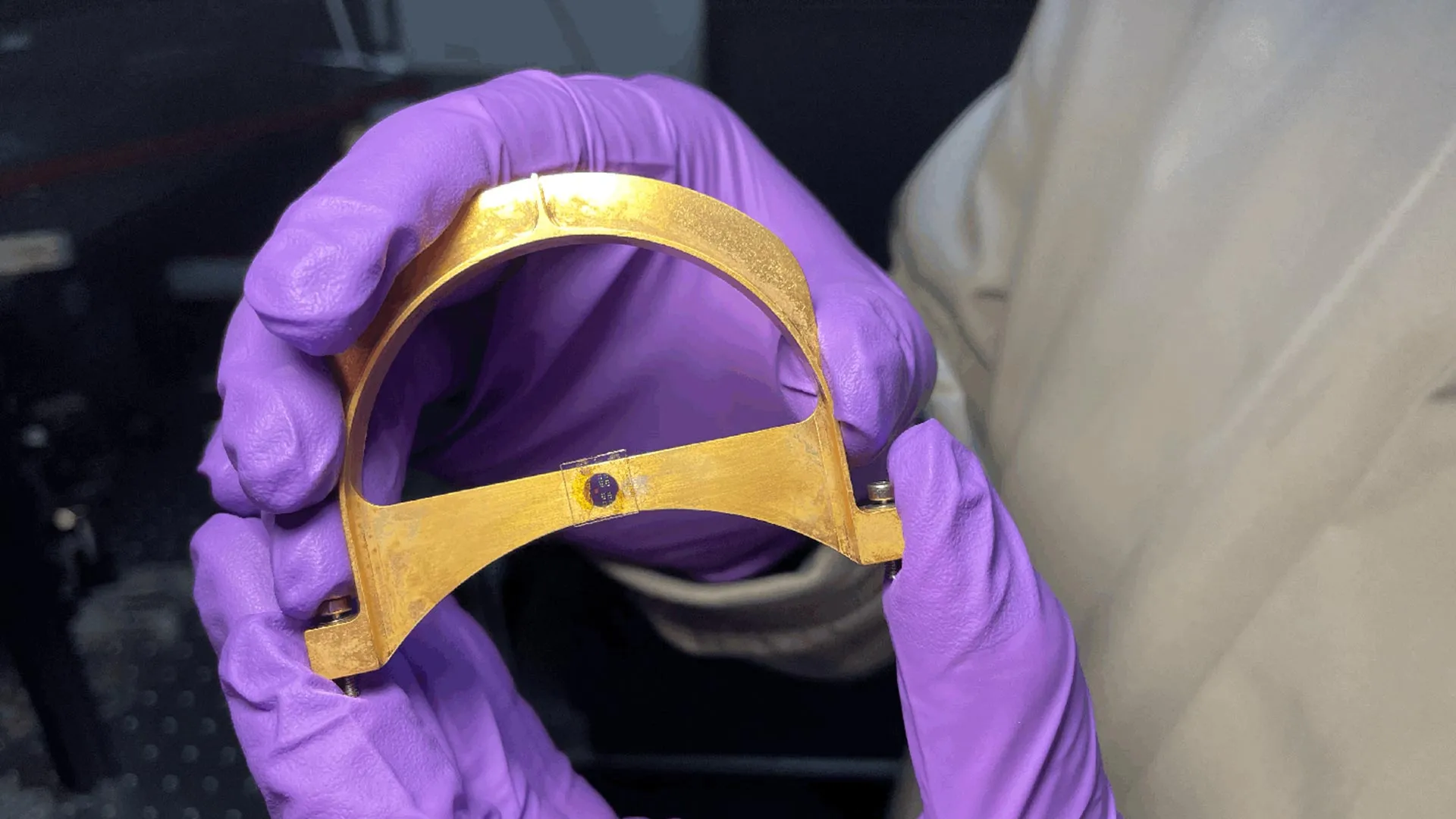
A Stanford team led by Jennifer Dionne, with first author Feng Pan and collaborators Fang Liu and Tony Heinz, publishes a nanoscale optical device in Nature Communications that entangles photons and electrons at room temperature. A patterned silicon nanostructure generates 'twisted light' — photons that carry orbital angular momentum as they propagate — which transfers spin to electrons in a thin layer of molybdenum diselenide (MoSe2), a two-dimensional transition-metal dichalcogenide semiconductor. Because MoSe2 naturally sustains strong spin correlations even when warm, the device avoids the millikelvin cryogenic cooling required by superconducting and trapped-ion qubits. 'The material in question is not really new, but the way we use it is,' said Dionne. The work builds on preliminary results Stanford previewed in December 2025 and could enable smaller, cheaper quantum communication components outside specialized labs.
Media
Sources
- T2 ScienceDaily — Stanford room-temperature quantum signaling, May 30, 2026 Major western
- T2 SciTechDaily — Room-Temperature Quantum Device Major western