and extracts the following text as a script body — the dev server then fails its dependency scan with `Expected ";" but found "non"` from the words "non-allowlisted hosts", which breaks e2e. So, what this buys, so nobody reads more or less into it: blocks external `script src=` from non-allowlisted hosts blocks injected inline scripts — each one is pinned by hash blocks fetch/XHR/WebSocket exfiltration (connect-src allowlist) blocks form-action, base-uri, object-src vectors does not stop image-based exfiltration — img-src must allow https: because event media comes from arbitrary publishers' og:image The cost of hashing is that an inline script edited after the hashes are computed is silently refused by the browser. That is why the violation reporter below exists: report-uri/report-to are ignored in a meta element and Pages serves no CSP header, so violations are caught in-page and sent to PostHog instead (src/lib/csp-report.ts, #241). frame-ancestors is deliberately NOT in this string: it is ignored in a meta element and browsers log a warning about it on every page load. It lives in public/_headers instead, ready for a CDN in front of Pages. X-Frame-Options (set there too) is the clickjacking control that actually applies today. */ }
political high confidence

Türkiye Signs Artemis Accords as 71st Signatory

| Artemis II

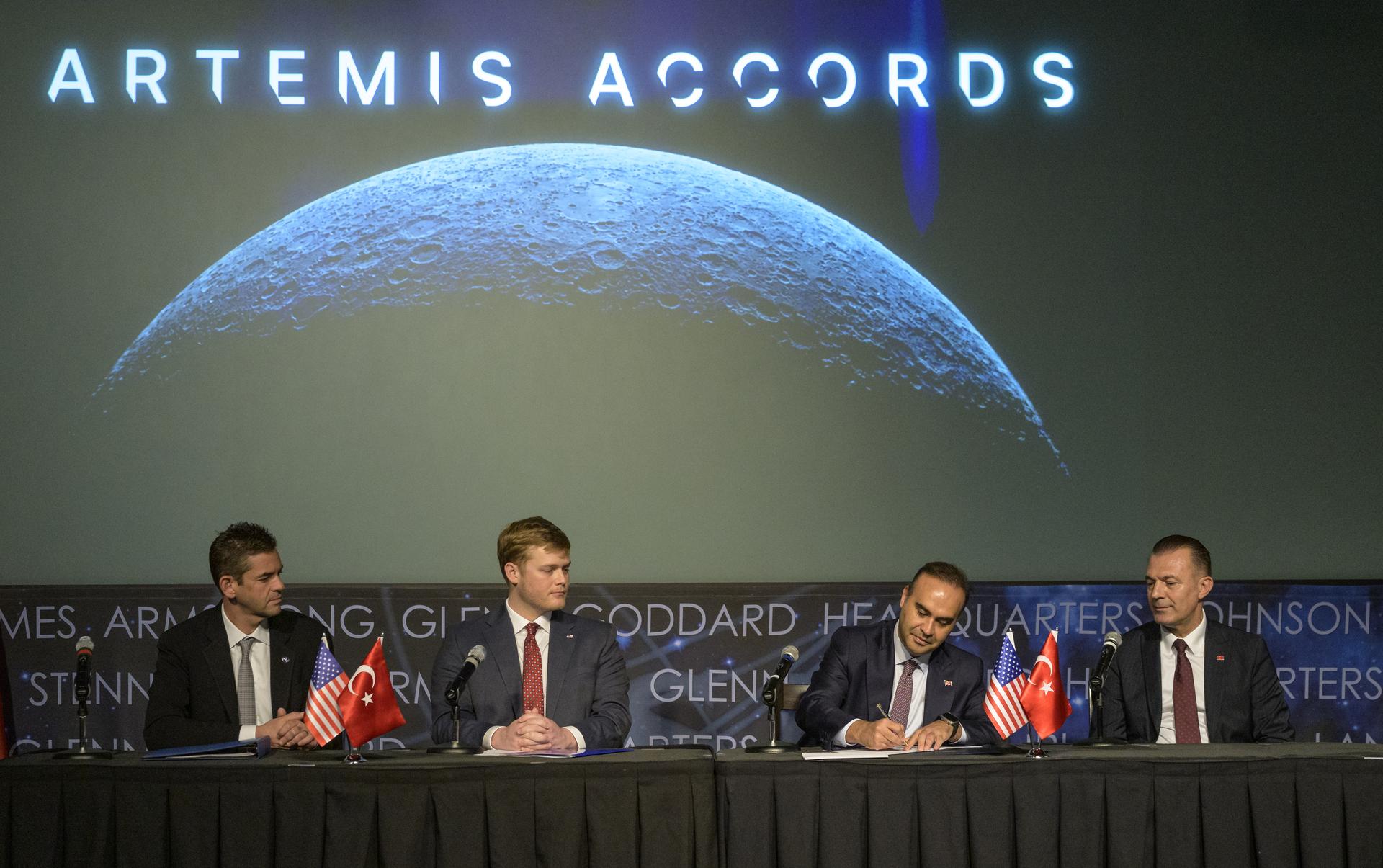
Türkiye's Minister of Industry and Technology Mehmet Fatih Kacır signed the Artemis Accords on behalf of the Republic of Türkiye on August 31, 2026, at a ceremony hosted by NASA Administrator Jared Isaacman at the Mary W. Jackson NASA Headquarters building in Washington, with Turkish Space Agency President Yusuf Kıraç and U.S. Deputy Assistant Secretary of State for Space and Environment Connor Tomlinson also present. Türkiye became the 71st nation to sign. Isaacman said, "It is my privilege to welcome the Republic of Türkiye as the 71st signatory of the Artemis Accords," and noted NASA has invited every signatory to contribute hardware, payloads, technology demonstrations and CubeSats to future Artemis missions. Türkiye plans to send its first lunar spacecraft, AYAP-1, to the Moon in 2027 and will host the International Astronautical Congress in Antalya in October 2026.

Turkish Minister Mehmet Fatih Kacır signs the Artemis Accords at NASA Headquarters, Aug. 31, 2026
Turkish Minister Mehmet Fatih Kacır signs the Artemis Accords at NASA Headquarters, Aug. 31, 2026 — NASA