and extracts the following text as a script body — the dev server then fails its dependency scan with `Expected ";" but found "non"` from the words "non-allowlisted hosts", which breaks e2e. So, what this buys, so nobody reads more or less into it: blocks external `script src=` from non-allowlisted hosts blocks injected inline scripts — each one is pinned by hash blocks fetch/XHR/WebSocket exfiltration (connect-src allowlist) blocks form-action, base-uri, object-src vectors does not stop image-based exfiltration — img-src must allow https: because event media comes from arbitrary publishers' og:image The cost of hashing is that an inline script edited after the hashes are computed is silently refused by the browser. That is why the violation reporter below exists: report-uri/report-to are ignored in a meta element and Pages serves no CSP header, so violations are caught in-page and sent to PostHog instead (src/lib/csp-report.ts, #241). frame-ancestors is deliberately NOT in this string: it is ignored in a meta element and browsers log a warning about it on every page load. It lives in public/_headers instead, ready for a CDN in front of Pages. X-Frame-Options (set there too) is the clickjacking control that actually applies today. */ }
political high confidence

NASA Administrator Isaacman: "Extremely Confident" Artemis III Launches in 2027, Details Three-Launch Mission Sequence

| Artemis II

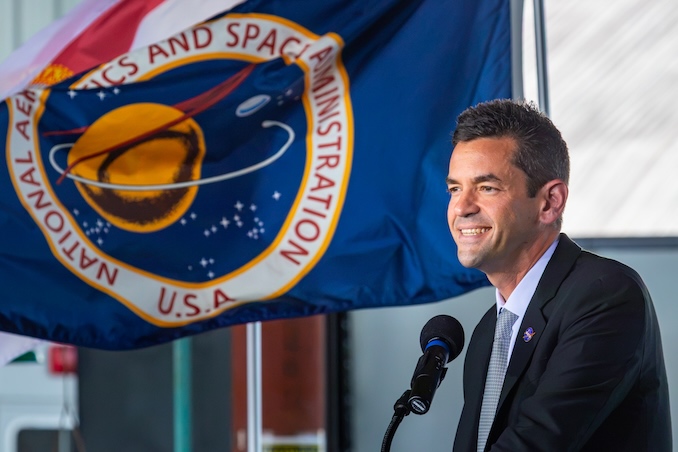
Speaking at Kennedy Space Center on August 14, 2026 while announcing the sponsor-driven "Max Power" air and space expo (Nov. 7-8, 2026), NASA Administrator Jared Isaacman said he is "extremely confident" the Artemis III mission will launch in 2027. He laid out the mission's three-launch sequence: Blue Origin's New Glenn will fly first carrying a Blue Moon Mark 2 test lander with life-support and crew-habitation areas, followed days later by the SLS rocket with the Orion spacecraft, and then SpaceX's Starship Version 3 with a docking adapter. Isaacman, who recently visited Blue Origin's assembly line, said the mission is designed to "bring down" risk ahead of Artemis IV, and called SpaceX's rising launch cadence "critical," noting the company plans a launch in early September and roughly one every couple of weeks through year-end with hardware already being cut for the next test vehicle.

NASA Administrator Jared Isaacman speaks at Kennedy Space Center, Aug. 14, 2026
NASA Administrator Jared Isaacman speaks at Kennedy Space Center, Aug. 14, 2026 — Spaceflight Now